

What Shumi runs
A buy-only mean-reversion strategy with a longer-term trend gate.
- Buy-only, never short. Shorts in a real rally get crushed. They keep bleeding because there's no clean exit catalyst. So Shumi doesn't take them.
- Mean reversion. Buy after a stretched-down move, expect a bounce. That's the whole entry thesis.
- Trend gate on top. The longer-term trend has to be up before any buy is allowed. If the trend rolls over, no new buys.
- Four ways out of every entry. An entry can close on a clean reversal signal (the strategy's preferred exit), or on max hold time if no clean signal arrives, or on a 30% maximum-loss stop, or on a 30-day cooldown before re-entry.
- Universe. 79 coins.
The outcomes
Top winners: ENA +49%, TIA +33%, OP +24%, COMP +21%, JUP +18%.
Biggest losses: INJ −24%, SOL −23%, DOT −20%, PENGU −20%, ETC −18%.
Twelve outcomes closed on a clean reversal signal. Every one of those twelve was a winner. The other eleven hit the maximum hold without the bounce arriving. Two of those eleven still timed out green (ALGO +17%, SKY +6%); the other nine timed out red. Zero outcomes hit the 30% emergency stop. The 30-day cooldown blocks re-entry on coins that just exited.
Five winners carried most of the upside. A handful of outcomes pays for the rest of the ledger. That's normal for this kind of system. Full table sits in the panel.
Why no shorts
Same strategy with shorts allowed, same window: 46 short positions still open and underwater on May 7. One ZEC short, down 143%.
The trend gate blocked all of them. That's what it's there for. Mean-reversion shorts in a real rally don't snap back. The stretched move keeps stretching, with no clean exit catalyst. The gate reads the bigger trend first and refuses shorts when the trend is up.
What Shumi sends each morning
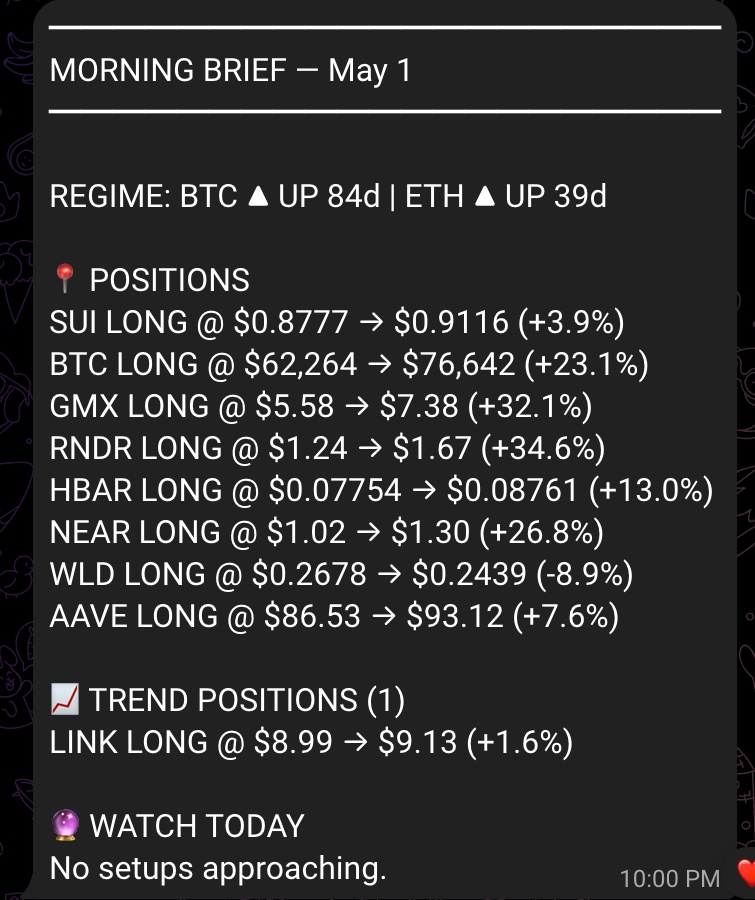
One of the surfaces Shumi will speak through is Telegram. A daily brief at 09:00 Bangkok with the trend status, every open position, and the watch list. Same format every day. (Public Telegram channel coming soon.)
Below is the brief from May 1. Eight open positions. Seven up, one down (WLD). Shumi also runs a separate trend-following strategy; the one trend-following position (LINK) is visible at the bottom of the message but isn't part of this article. Seven of the eight mean-reversion positions are still open today.
The nine tests
The strategy has to clear nine specific tests before any change ships. Each one looks for a different way the result could be fake.
- Beats random ✓. The strategy's results beat random entries by enough to call it real edge.
- Reproducibility ✓. Re-running on the same data produces identical outcomes. No hidden randomness.
- Cross-strategy sanity ✓. The mean-reversion strategy and the trend-following strategy agree on the basics where they should.
- Correlation in stress ✓. When the market falls, Shumi's holdings move together the way the design predicts.
- Data freshness ✓. Every market input is current, nothing stale.
- Runnability ✓. Every coin in the universe can actually be processed end-to-end.
- Parameter sensitivity ⚠. A known soft spot: small changes to one timing setting move results more than we'd like.
- Entry-timing tolerance ⚠. The strategy survives small jitter in when bars arrive. We haven't closed this out as a non-issue.
- Held-out test ⚠. The big one. A clean slice of data Shumi has never seen, run blind. Queued. Not yet shipped.
What's public, what stays private, and what you can do with each
Public. Enough to audit the method. The strategy type (mean reversion with a trend gate). The four exit paths and the 30% stop. The 79-coin universe. The nine tests, with which passed and which didn't. Every outcome in the panel: real entry and exit dates, real Hyperliquid prices, real percentage returns. A careful reader can use this to check whether the structure is reasonable, whether the tests catch the right failure modes, and whether the outcome ledger is consistent with the strategy description.
Private. The specific timing thresholds. What counts as "stretched-down enough" to buy. What counts as "trend is up." The exact ranking weights when multiple coins qualify. These numbers came out of 400+ experiments, and they're the thing that competes the edge to zero if published. Without them, a clean-room rebuild would land in approximately the right neighborhood and then have to do its own optimization from scratch, which is the work we did.
The receipts
Twenty-three outcomes produced by the Shumi trading engine, closed between April 3 and May 7, 2026. Real entry and exit prices from Hyperliquid OHLCV. Rules: buy after stretched-down moves, only when the longer trend is up, with a 30% maximum-loss exit and a maximum hold time. Trading fees are excluded; over a five-week window with low fees, including them would shift the headline numbers by under half a percentage point.
Per-outcome returns, compounded one at a time (single-position simulation, not portfolio P&L)
Indexed to 100 · each outcome compounds gross price P&L into running equity · 23 out-of-sample outcomes · training periods shown in walk-forward section below
Known Limitations
- Five weeks is a short window. The claim is 'Shumi behaved the way the design predicted during this rally,' not 'the strategy is validated.'
- The ZEC counterfactual carries weight. Without it, 'no shorts' reads as cherry-picking. With it, the choice is visibly defensible.
- The held-out test still hasn't been run. The rally happened in real time with Shumi live, which is not the same as running blind against data the strategy has never seen.
- Five outcomes carry most of the upside. That's normal for mean reversion, but worth saying out loud.
- Fees aren't included. Over this five-week window the impact is small (<0.5pp on headline numbers).
Trade Journal
23 outcomes · 23 assets · long only · Apr 3 – May 7, 2026| Date | Asset | Entry | Exit | P&L |
|---|---|---|---|---|
| 2026-03-30 | AAVE | $96.83 | $101.06 | +4.2% |
| 2026-02-02 | ALGO | $0.1048 | $0.1230 | +17.1% |
| 2026-03-09 | ARB | $0.0975 | $0.1108 | +13.4% |
| 2026-02-02 | ATOM | $1.98 | $1.69 | -15.0% |
| 2026-02-02 | AVAX | $10.14 | $8.91 | -12.4% |
| 2026-04-02 | COMP | $16.64 | $20.12 | +20.7% |
| 2026-03-09 | CRV | $0.2419 | $0.2432 | +0.3% |
| 2026-02-02 | DOT | $1.54 | $1.24 | -19.9% |
| 2026-04-04 | ENA | $0.0800 | $0.1198 | +49.4% |
| 2026-02-02 | ETC | $9.81 | $8.07 | -17.9% |
| 2026-02-02 | INJ | $3.66 | $2.79 | -23.9% |
| 2026-03-30 | JUP | $0.1511 | $0.1785 | +18.0% |
| 2026-03-30 | MANTA | $0.0608 | $0.0662 | +8.8% |
| 2026-03-29 | OP | $0.1015 | $0.1256 | +23.6% |
| 2026-02-02 | PENGU | $0.0078 | $0.0063 | -19.8% |
| 2026-02-07 | SAND | $0.0885 | $0.0807 | -9.1% |
| 2026-02-14 | SKY | $0.0704 | $0.0750 | +6.3% |
| 2026-02-02 | SOL | $104.50 | $80.31 | -23.4% |
| 2026-03-08 | STRK | $0.0381 | $0.0405 | +6.1% |
| 2026-03-09 | SUSHI | $0.1950 | $0.2116 | +8.3% |
| 2026-03-30 | TIA | $0.2936 | $0.3918 | +33.3% |
| 2026-03-03 | TON | $1.25 | $1.44 | +14.6% |
| 2026-02-21 | ZK | $0.0198 | $0.0167 | -15.9% |
14/23 wins · 60.9% WR